
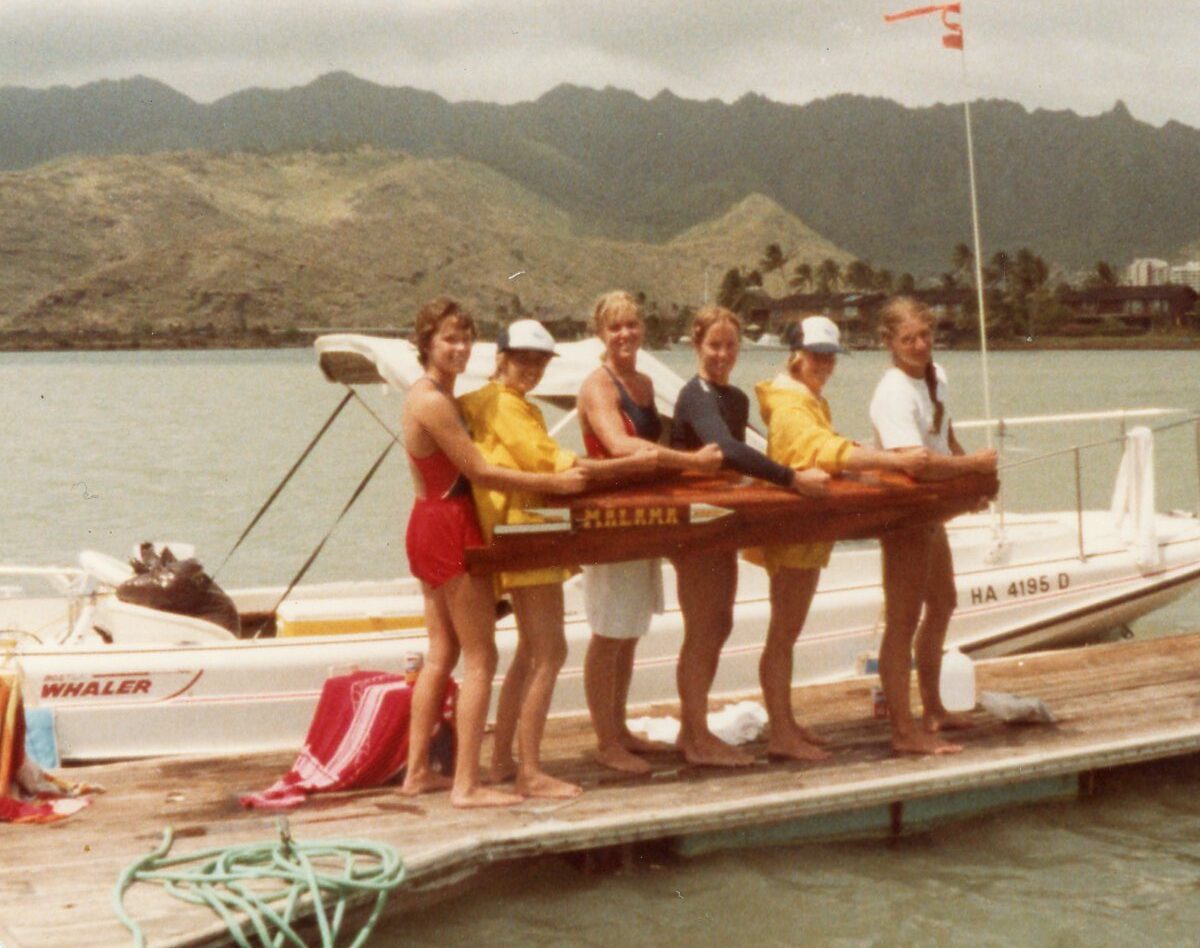
The most common definition of the Hawaiian word “Mālama” is: to take care of, tend, attend, care for, preserve, protect, beware, save, maintain. So what did the 1982 Offshore women’s outrigger team do when they raced a koa outrigger canoe named “Mālama” in that year’s Na Wahine O Ke Kai?
They broke it.
Not on purpose, of course!
This is Part 1 of NAC member’s full circle history with the “Mālama” outrigger canoe.
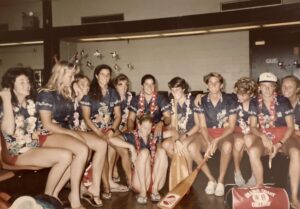
1982 Offshore Women’s Team Roster:
Jojo Toeppner, Natalie Rigolet, Mindy Clarke, Sheila Conover, Leslie Davis, Kim Del Valle, Angela Iacavino, Sue Halloway, Elaine Kaspar, Ellie Hynes, Carol Conover, Leslie Kline
1982
When Maui paddler, Kapena Whitford, found out the Offshore women were coming back for the 1982 Na Wahine O Ke Kai with the goal of winning, he generously offered them the use of his koa canoe, the Mālama.
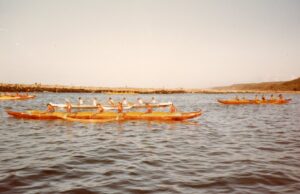
Heading out to the start line in the Mālama
Billy, who was the women’s coach, remembers getting that call and thinking, “Wow, that’d really be cool for the women, ’cause we had a pretty good run going. It looked like we had the guns to win the race. If we didn’t, then I wouldn’t have gone koa.” Meaning he would have wanted his crew to race in the then modern “fiberglass canoes” instead.
Descriptions of conditions of the Kaiwi channel are always in the eye of the beholder or more simply explained…who has been in it more times. Yet it is fair to say photos rarely do it justice! Paddler Elaine Kaspar remembers the 1982 channel being the gnarliest day on the water she had ever seen. While Billy recalls it being, “Not scary big, but decently big for that time of year.” The Moloka‘i Through the Years history book says the day of the race was sunny and had perfect conditions for good surfing in the channel.
The Offshore crew and their competition, Hui Nalu, took an early lead as they left the shelter of Moloka‘i and entered the Kaiwi channel. Around the three hour mark, the Offshore ladies were still battling for first with Hui Nalu when disaster struck.
The crew had just made a water change, and as steerswoman Kim Del Valle was zipping up the spray skirt, the canoe was broadsided by a big wave. The wave pitched the canoe up, up and flipped the canoe over the ama. To huli or flip the canoe over the ama in the open ocean–instead of the ama flipping over the hull of the canoe–is an extremely rare occurrence.
Jojo Toeppner, Sheila Conover, and Mindy Clarke had just gotten out of the canoe for their water change. Sheila recalls looking back and seeing seat six of the canoe high up on the crest of a swell, and then all of a sudden getting plucked out of the water and into the escort boat. People frantically calling out, “Get in the (escort) boat!” because the canoe had flipped. While Elaine, who was in seat three or four in the canoe, clearly remembers seeing the ama literally go under the water and saying to herself, “That’s not good!”
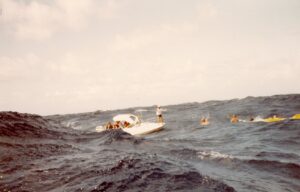
Billy directing from the escort boat
Normally, when a canoe flips in a race it’s not the end of the world–you just right it, bail the water out and get back to racing–but unfortunately two things added to the disaster. One: after they righted the canoe, someone hopped back in to try and bail water out, adding weight and further sinking the canoe. Billy recalls by the time the escort pulled up to the canoe it was almost submerged. He ordered, “Get out, get out!” and to use their hands to bail the water, to try and close the spray skirts–but it was no use. Any headway they made was reversed by the large swells, white washing over the entire length of the canoe filling it again and again with water.
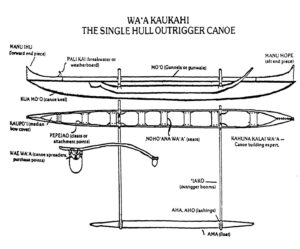
“That was the kiss of death–the boat was submerged,” Billy said. “There was no way to right it.” They tried all the tricks, flipping it over again, getting the ama in the air, none of it worked. Which brings me to the second reason flipping that day was a disaster: the Offshore women were racing in a koa canoe. And unlike fiberglass canoes, the Mālama didn’t have air tanks (flotation tanks) in the manus–the front and back of the canoe–which help keep canoes afloat.
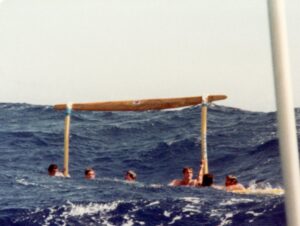
Support team trying all the tricks to get the water out of the Mālama
When they realized they were not able to get the water out of the canoe, Billy made the only call he could…the race for the Offshore women was over. But it’s also where the second disaster of the story begins.
Billy and Bud Hohl decided to take the spray skirts off the back half of the canoe and get a line on the bow to start towing it forward, in hopes that once the canoe was moving the water in the canoe would flow out the back and empty. It didn’t work. So they tried it again. Tied another bridle under seat one, started towing it forward and you can guess it…pulled the nose right off the canoe.
“There goes the manu–still intact, and there goes the canoe,” Billy said as we talked, pointing in two different directions all while shaking his head like he still couldn’t believe it after all these years.
Lucky enough, the crew had two escort boats and they were able to start picking up as many splintered pieces of the canoe as they could. Meanwhile, half the team aboard the escorts were getting violently seasick as they floated up and down in the large swells. Sheila, who had never been seasick in her life, remembers trying to help teammate Sue Holloway. “It’s going to be okay, Sue. It’s going to be okay,” she said, right before she sat down herself and promptly got sick as well.
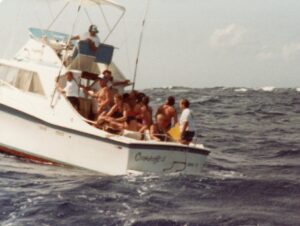
The team having a…great time on the escort boat
It was decided to send one escort back to O‘ahu with half the team, and then use the other to try towing it again because leaving the broken Mālama in the middle of the channel was not an option for them. Billy, Bud and the other helpers turned the canoe around, and tied another line at the stern to tow it backwards with the hopes that the water would flow out the now missing nose or manu of the hull. Their hopes were in vain. With a three knot current going against them, the escort was only able to get up to maybe 5 knots, so the canoe would not empty. Still, they did not give up–they were in for a long slow day back to shore. As Billy said, “It took forever.”
To make matters worse, the canoe flipped over multiple times while towing. The solution? Billy and Bud took turns sitting on the back ‘iako near the ama, holding onto the line for hours at a time. Billy took the first shift. And since it seemed like nothing could go right, it only made sense that Billy would accidentally slip off the ‘iako without anyone noticing. “Billy was there one moment, and then I looked back and he wasn’t!” Sheila said, recalling how her teammate Angela recounted the story to her later. When I asked Billy how long he was in the water before anyone noticed, all he said was, “It took a while.”
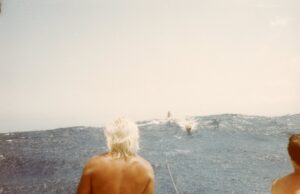
Bud surfing the broken Mālama
Billy remembers Bud’s turn in the canoe with a lot more fondness. When they finally reached Haunama Bay on O‘ahu, the end was in sight, but the current was still ripping against them causing the swells jack up and making towing even more hairy. Billy recalls watching as Bud, now in the canoe itself instead of on the ‘iako, going up on the crest of a huge wave, when the tow line suddenly tugged just at the right time. Finally, with the right angle and speed, the water in the hull began to shoot out the broken and open end! “So all of a sudden,” Billy said, grinning the whole while, “The canoe is coming up on the surface and Bud is surfing! I don’t want to exaggerate, but he was surfing a 12-15 foot wave in the broken canoe screaming out, YEEEEHAWWW!”
The canoe, of course, flipped after this, tangling up the tow lines causing more delays, but they eventually made it back to shore, landing in Hawai‘i Kai. Back on land, they were met by race organizers where they may or may not have been called names (they were, but we won’t repeat them here!) for their reckless attitude towards the safety of…you know their lives, but they all made it back to shore, including practically every single broken piece of the Mālama.
Which was important for many reasons, but most pressing was that the Offshore Men’s team was due to race it in the Moloka‘i Hoe in two weeks!
Stay tuned for Part 2: The Fix
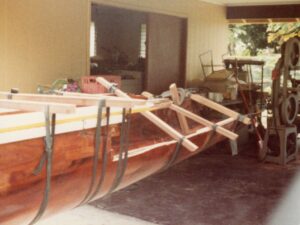
The Mālama getting race ready
Brief Backstory & Definitions:
Before the NAC came into existence, many NAC outrigger members paddled for Offshore Canoe Club—a canoe club that has a long and winning history—but that’s another story for another time. What you need to know now is that Billy Whitford was the head coach. Jojo and Natalie are current members of NAC women’s outrigger team, Elaine, Sheila, Mindy, Bud and are all still involved with NAC and outrigger paddling in multiple capacities.
Na Wahine O Ke Kai – Women’s Moloka‘i to O‘ahu outrigger race
Moloka‘i Hoe – Men’s Moloka‘i to O‘ahu outrigger race
Koa canoe – Outrigger canoe made from a koa tree
Fiberglass canoe – Outrigger canoe made with fiberglass and “modern” materials
Kaiwi Channel – The channel between Moloka‘i and O‘ahu – considered one of the most dangerous channels in the world
Water Change – Where extra paddlers jump off escort boats into the water, and pull themselves into the outrigger to allow paddlers breaks during long distance races
Escort Boat – A motor boat that follows their canoe, and carries the coach and extra paddlers to facilitate water changes.
Well done! Great history. Keep them coming.